Artificial Grass in Qatar: A Practical Guide
Pile height, drainage, heat and UV: what to specify, and why the base underneath decides how it looks in three years.
Updated by Al Arabia Carpets
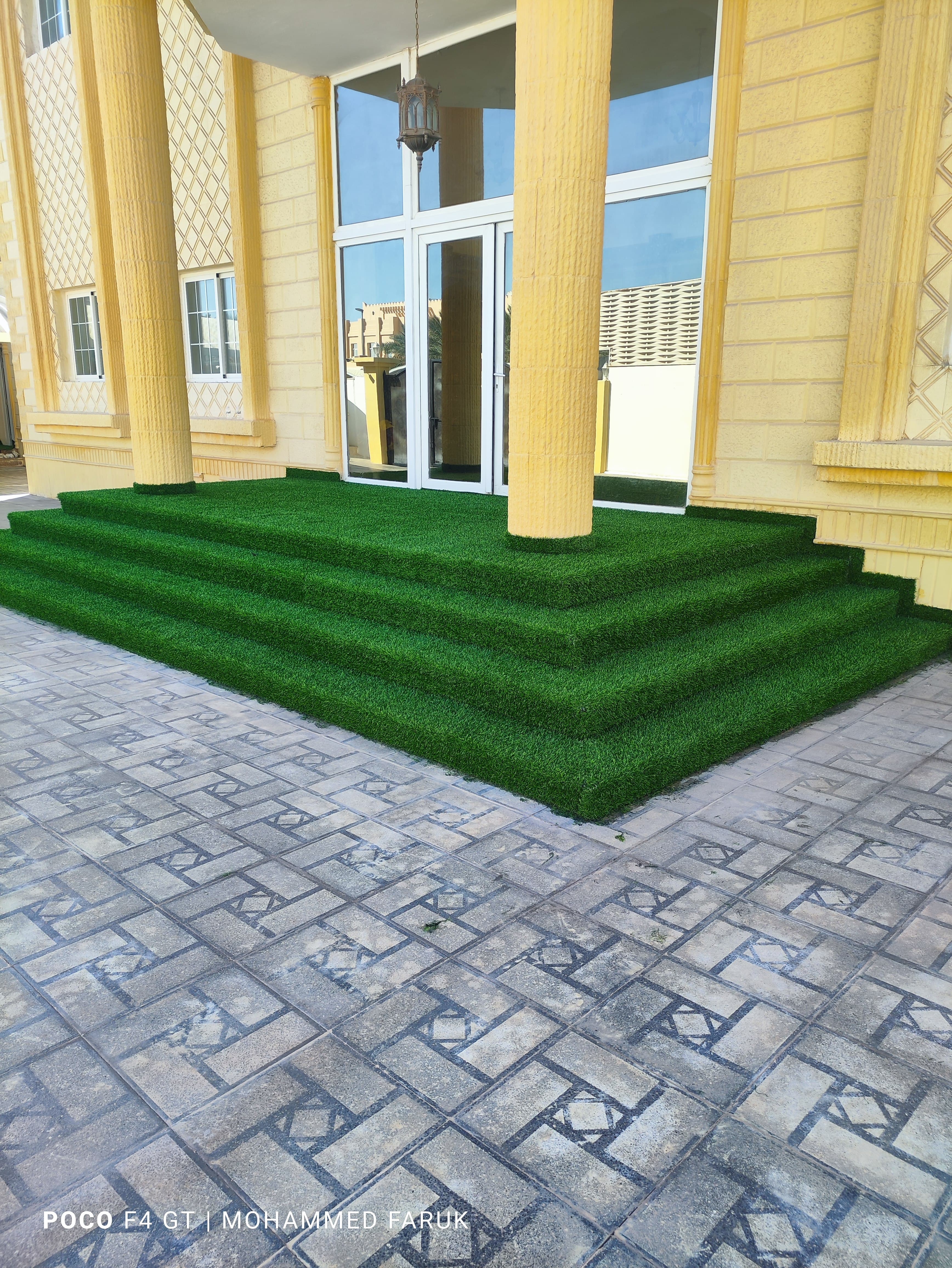
Artificial grass makes obvious sense in Qatar. A real lawn here needs constant water and constant attention, and still struggles through the summer. Grass carpet stays green with almost no input.
The catch is that the quality of the finished job depends far less on which grass you buy than on what goes underneath it. This guide covers both, in the order they matter.
The base matters more than the grass
Almost every artificial lawn that looks bad after a couple of years looks bad for the same reason: the base moved. Grass laid straight onto loose sand develops dips and ripples that no amount of brushing will fix, because the problem is under the surface.
A properly built base is compacted in layers and free-draining, so it stays where it was put and lets water through. It is the least visible part of the job and the part worth paying for.
Drainage, especially on roofs and balconies
Artificial grass has a perforated backing, so water passes through it rather than running off. That water then has to go somewhere.
On a garden this is usually straightforward. On a roof terrace or balcony it needs surveying properly, because the existing drainage outlets must keep working. Grass and base built up over an outlet turns a terrace into a shallow tank, and the first anyone knows about it is water appearing where it should not be.
- Never build a base over an existing drainage outlet.
- Set the base falls toward the outlets that are already there.
- On balconies, check the finished grass height against door thresholds before starting.
Pile height and colour
Longer pile looks lush in photographs and flattens under traffic. Shorter, denser pile stands up far better on a path, a play area or anywhere people actually walk, and it also runs cooler in direct sun.
On colour, the more convincing products mix several shades of green with a brown thatch at the base, because a real lawn is never one flat colour. A single uniform green is the clearest sign of a cheap grass.
- Paths, steps and play areas: shorter, denser pile.
- Ornamental garden areas with light traffic: longer pile is fine.
- Look for mixed green shades and a brown root thatch.
- Check the product is UV-stabilised, not merely UV-resistant.
Heat, and what to do about it
Any surface in direct Gulf sun gets hot, and artificial grass is no exception. It is worth being honest about this rather than pretending otherwise.
Three things reduce it: a lighter colour, a shorter pile, and shade. A hose-down brings the surface temperature straight back down and takes seconds. For a play area that sits in full sun all afternoon, we would talk through pile and colour with you before quoting rather than after.
Frequently Asked Questions
How long does artificial grass last in Qatar?
+
A UV-stabilised grass over a properly built base holds its colour and shape for many years of Gulf sun. When an installation fails early it is almost always the base rather than the grass, showing as dips and ripples long before the fibres themselves wear out.
Is artificial grass safe for children and pets?
+
Yes. The grass is non-toxic and drains freely rather than holding water. For play areas a shock-absorbing layer can be laid under the grass, and pet waste rinses off the surface instead of soaking in the way it would on a real lawn.
What maintenance does it need?
+
Very little. Brush the pile occasionally so it stands upright, rinse it down to clear dust, and remove leaves near planted areas. There is no mowing, watering or fertiliser, which for most people in Qatar is the entire point of fitting it.
Can it be laid on a roof terrace?
+
Yes, and it is one of the most common installations here. The critical requirement is that the existing drainage outlets keep working, so the falls need surveying and the base built to move water toward them rather than letting it sit underneath the grass.