Office Carpet Tiles: A Guide for Qatar Workplaces
Tiles or broadloom, what wears fastest, why acoustics matter more than people expect, and how to fit without closing the office.
Updated by Al Arabia Carpets
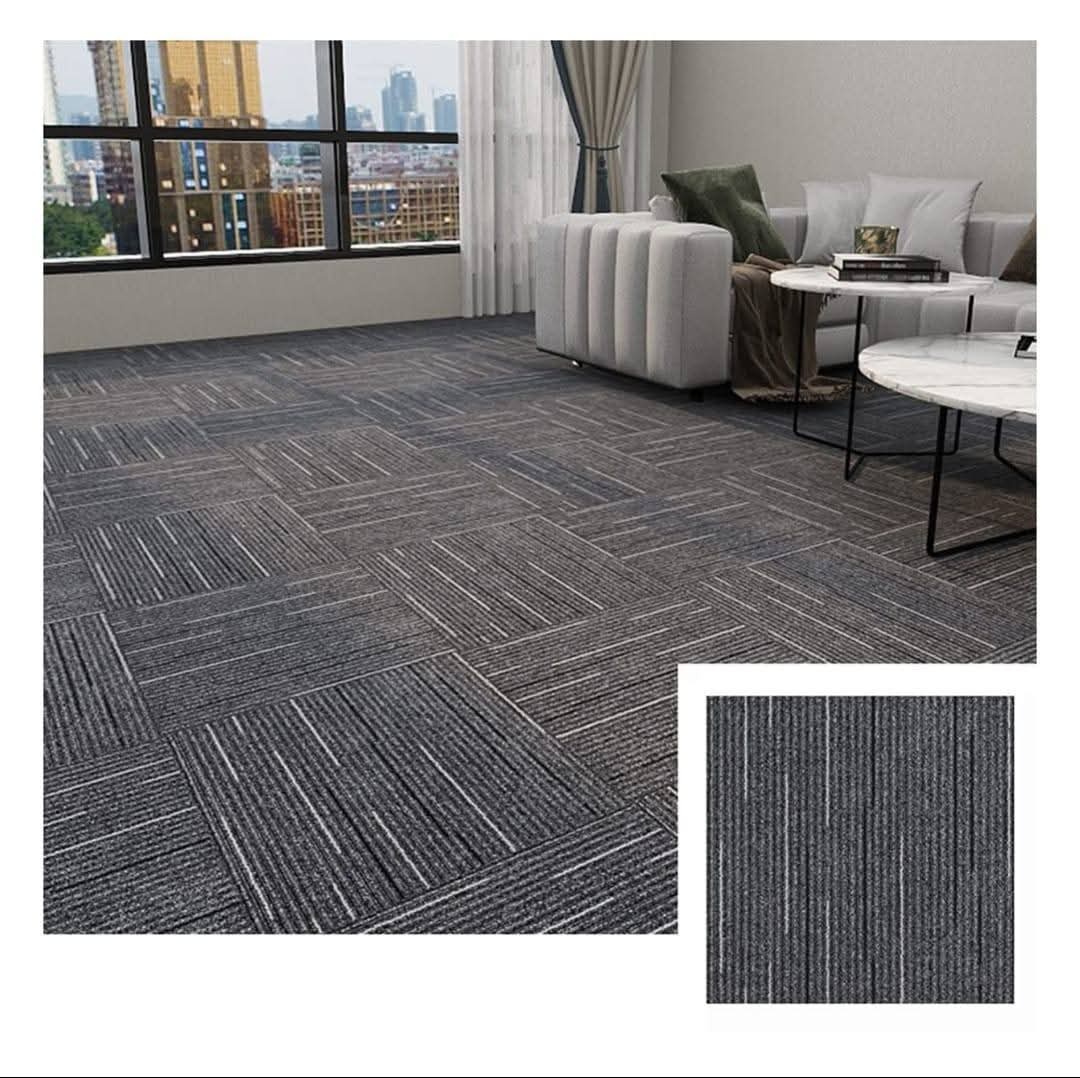
Office flooring gets specified once and then walked on by a hundred people a day for years. It is worth ten minutes of thought, because the difference between a good and a bad decision here shows up as either a floor that still looks presentable in year five, or one that needs replacing in year two.
This guide covers the decision as it actually comes up in Doha offices: tiles or broadloom, what to specify, and how the fit-out is sequenced around a team that still has to work.
Tiles or broadloom
For most offices, carpet tiles win, and the reason is repairs rather than looks. Coffee gets spilled, chair castors wear a patch by every desk, and a contractor drops something. With tiles you lift the affected tile and drop in a replacement. With broadloom you live with the mark or re-carpet the room.
Broadloom still has a place. In a boardroom or a director's office, where the floor is seen as one continuous surface and the traffic is light, a seamless carpet looks better than a grid of tiles ever will.
- Open-plan floors, corridors and lift lobbies: tiles.
- Boardrooms, cellular offices, executive areas: broadloom is defensible.
- Anywhere with floor boxes and heavy cabling: tiles, because access is far easier.
Ask for attic stock, always
The single most useful thing you can put in an office carpet specification is a quantity of spare tiles from the same production batch, stored on site.
Carpet dye lots shift. A tile ordered in two years' time will be close but not identical, and on a plain colour the difference is obvious under office lighting. Spare tiles from your own batch make a future repair invisible. It costs very little at the point of order and cannot be bought later at any price.
Acoustics are a real part of the specification
In open-plan space, carpet is doing acoustic work as much as decorative work. Hard flooring reflects footfall, chair movement and conversation, and all of it adds to the background level people are trying to concentrate through.
This is the argument that usually convinces a finance director: an open-plan floor on hard flooring is measurably harder to work in, and carpet is the cheapest intervention available. It costs far less than acoustic ceiling treatment and works on the surface generating most of the noise.
Fitting without closing the office
Almost no business can hand over an empty floor for a week, so office carpet is normally fitted in phases, in the evenings or at weekends, department by department.
The practical constraint is desks and cabling. A phase involves moving furniture aside, lifting the old covering, laying the new tiles and putting everything back before the next working morning. Tell your fitter about floor boxes, server rooms and anything that cannot be powered down, because those dictate the sequence more than the floor area does.
Frequently Asked Questions
How long do office carpet tiles last?
+
A contract-grade tile in a normal office holds up for many years, and because tiles are replaced individually the floor has no single end-of-life date. Corridors, doorways and lift lobbies wear several times faster than open-plan areas, which is exactly why spare tiles matter.
Can carpet tiles be rotated to even out wear?
+
Yes, and it is a genuinely useful maintenance tactic. Tiles from a worn doorway can be swapped with tiles from under a rarely-moved cabinet, spreading the wear across the floor and pushing back the point where the carpet needs attention. Plain and non-directional patterns make this easiest.
What is a quarter-turn layout?
+
It means each tile is laid rotated ninety degrees from its neighbour, so the pile direction alternates. It disguises small shade variations between tiles and makes future replacements blend in. Laying all tiles in the same direction, called monolithic, looks more like broadloom but shows replacements more clearly.
Do we need to remove the old flooring first?
+
Normally yes, and it should be included in the quote rather than added as an extra. Laying new tiles over an old covering traps whatever condition is underneath, and any unevenness or loose sections will show through the new floor within months.